
B1-B Lancer
Supersonic strategic bomberFielded 1984Pending verification
Air ForcesUSA
Fact cardConfidence · Source
System
TypeSupersonic strategic bomber
Date of introduction1984
ProliferationOrigin country only
Dimensions and weight
Flight performance
Protection
Armament and payload
Carriage and releaseThree internal weapons bays, comprising 9.53 m (31 ft 3 in) double bay forward of wing carry-through structure and a single 4.57 m (15 ft) long bay aft, with hydraulically actuated doors.Med[1]
Guided weapon systemsThe forward and aft bays can be combined to carry eight ALCMs on a common strategic rotary launcher. Latest-generation GPS-guided precision weapons incorporated from CMUP Block D with Joint Direct Attack Munition (JDAM) and then Block E added AGM-154 Joint…Med[1]
Unguided weapons and gunsInternal capacity for up to 38,328.5 kg Mk 82 bombs or 500 lb Mk 36 mines. From 1996 Block C CMUP CBU-87 capability was added and, in April 1997, Mk 62 Quick Strike underwater mine seeding capability was added.Med[1]
Fire control
Sensors noteQuadruplex Automatic Flight Control System (AFCS) controls flightpath, roll attitude, altitude, airspeed, autot-hrottle, and terrain-following.Med[1]
Variants
B-1A LancerThe B-1A Lancer, 4 x prototypes were part of the initial B-1 program. It had its first flight in December 1974. The program was cancelled in 1977.[1]
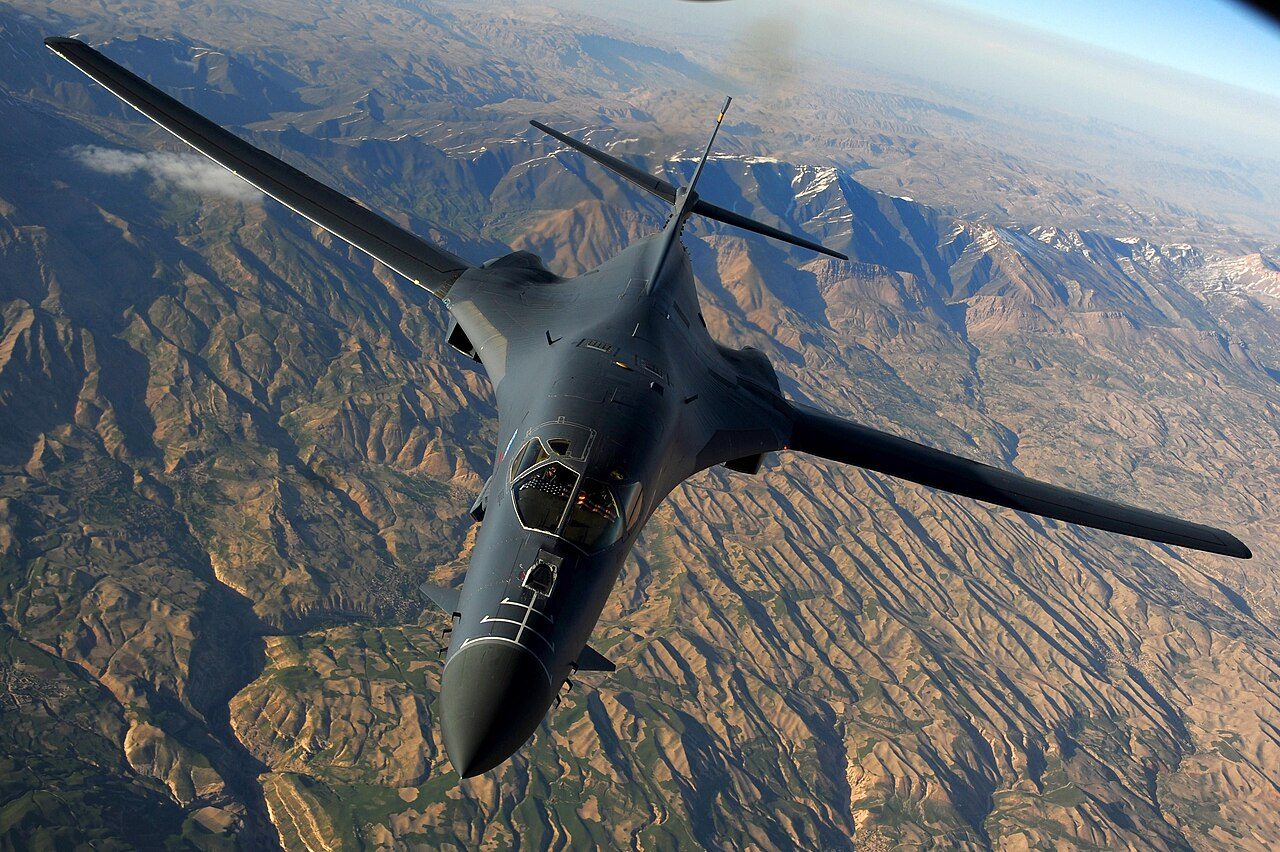
The B1-B Lancer American Supersonic Strategic Bomber manufactured by Boeing (originally developed by Rockwell International) in the United States. Development for the B-1B was revived in 1981 following the initial B-1A and first flight for the B-1B was completed in 1984.
Draft entry. Values come from the cited public sources and are awaiting editor verification.
- B1-B Lancer American Supersonic Strategic Bomber , U.S. Army TRADOC G-2 Worldwide Equipment Guide (ODIN)
Published/updated 2026-03-20 · Tier 1 · checked 2026-10-10
- 2026-10-10 Entry created from the Worldwide Equipment Guide (ODIN), bulk import
- 2026-10-10 Added photo (Public domain)