
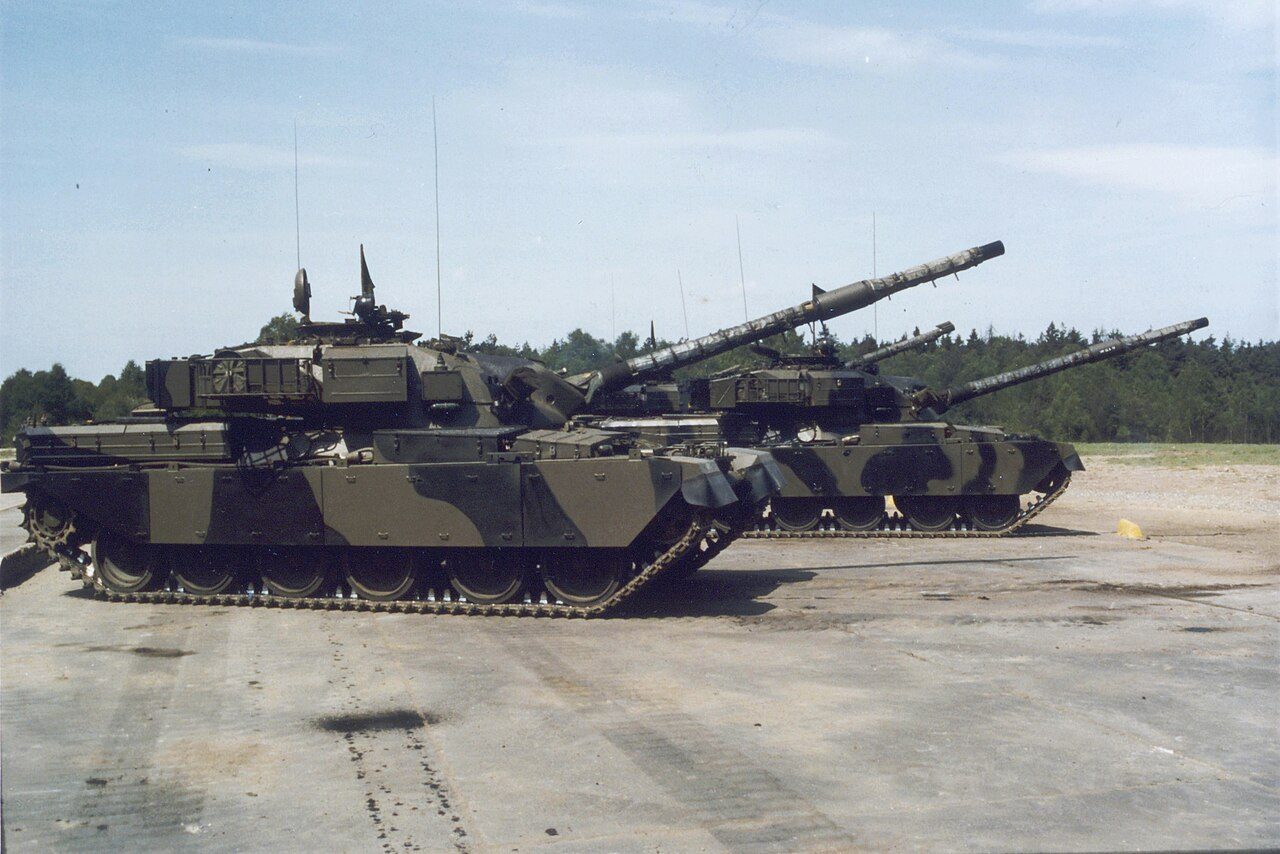
Chieftain MK 5
Main battle tankFielded 1975Pending verification
Land ForcesGBR
Fact cardConfidence · Source
System
TypeMain battle tank
Date of introduction1975
ProliferationAt least 4 countries
Dimensions and weight
Automotive performance
Protection
Smoke EquipmentYes, on each side of the turret there is six electrically-operated 66 mm smoke grenade dischargers.Med[1]
Armament
Fire control
Variants
FV4202 "40-ton Centurion"Test vehicle built by Leyland Motors using Centurion components to test reclining drivers position and mantlet-less turret proposed for FV4201. One built, 1956, official specification for FV4201 issued August 1958.[1]
FV4201 P1 - FV4201 P7Prototypes. Seven built, 485 hp L60 Mk 1 or 485 hp L60 Mk 4,initial vehicles had internal exhaust silencers, short hull. small diameter road wheels, weight 45 long tons, initial vehicles, 49.5 long tons for later vehicle[1]
Chieftain Mk.140 training vehicles for 1965–1966 with 585 hp L60 Mk 4 engine, strengthened TN12 gearbox, exhaust silencers moved to external armoured box on hull rear plate, larger 'Centurion' 31.6 inch diameter road wheels, re-positi[1]
Chieftain Mk.1/2Upgrade of Chieftain Mk.1 to Chieftain Mk.2 standard, fitted with 650 hp L60 Mk 4A2 engine, training use only[1]
Chieftain Mk.1/3Upgrade of Chieftain Mk.1, fitted with 650 hp L60 Mk 5A engine, training use only[1]
Chieftain Mk.2First service model with 650 hp L60 Mk 4A2 engine, L11A2 or L11A3 main gun,[viii] NBC system fitted to rear of turret, revised turret stowage, one-piece commander's hatch cover, armour removed from searchlight cover, rig[1]
Weapons and payload options · 3Confidence · Source
Armour-piercing fin-stabilized discarding sabot (APFSDS) L23120 mm ammunition
Med[1]- Quantity
- 64 total of any 120mm projectile combination
- Muzzle velocity
- 1,534 m/s
APFSDS L26 (CHARM 1)120 mm ammunition
Med[1]- Range
- 2.1 km1 mi · 1 nmi
- Quantity
- 64 total of any 120mm projectile combination
- Muzzle velocity
- INA m/s
HESH L31120 mm ammunition
Med[1]- Range
- 8 km5 mi · 4 nmi
- Quantity
- 64 total of any 120mm projectile combination
- Muzzle velocity
- 670 m/s
The Chieftain originated from a British Leyland design of a new tank, dating as early as 1950, when the War Office requested a replacement for the Centurion, as the Medium Tank No 2. The Mk.4 were two prototypes with increased fuel capacity and other minor modifications.
Draft entry. Values come from the cited public sources and are awaiting editor verification.
- Chieftain MK 5 British Main Battle Tank (MBT), U.S. Army TRADOC G-2 Worldwide Equipment Guide (ODIN)
Published/updated 2026-03-20 · Tier 1 · checked 2026-10-10
- 2026-10-10 Entry created from the Worldwide Equipment Guide (ODIN), bulk import
- 2026-10-10 Added photo (Public domain)