
F-4E Phantom II
Interceptor aircraftFielded 1972Pending verification
Air ForcesUSA
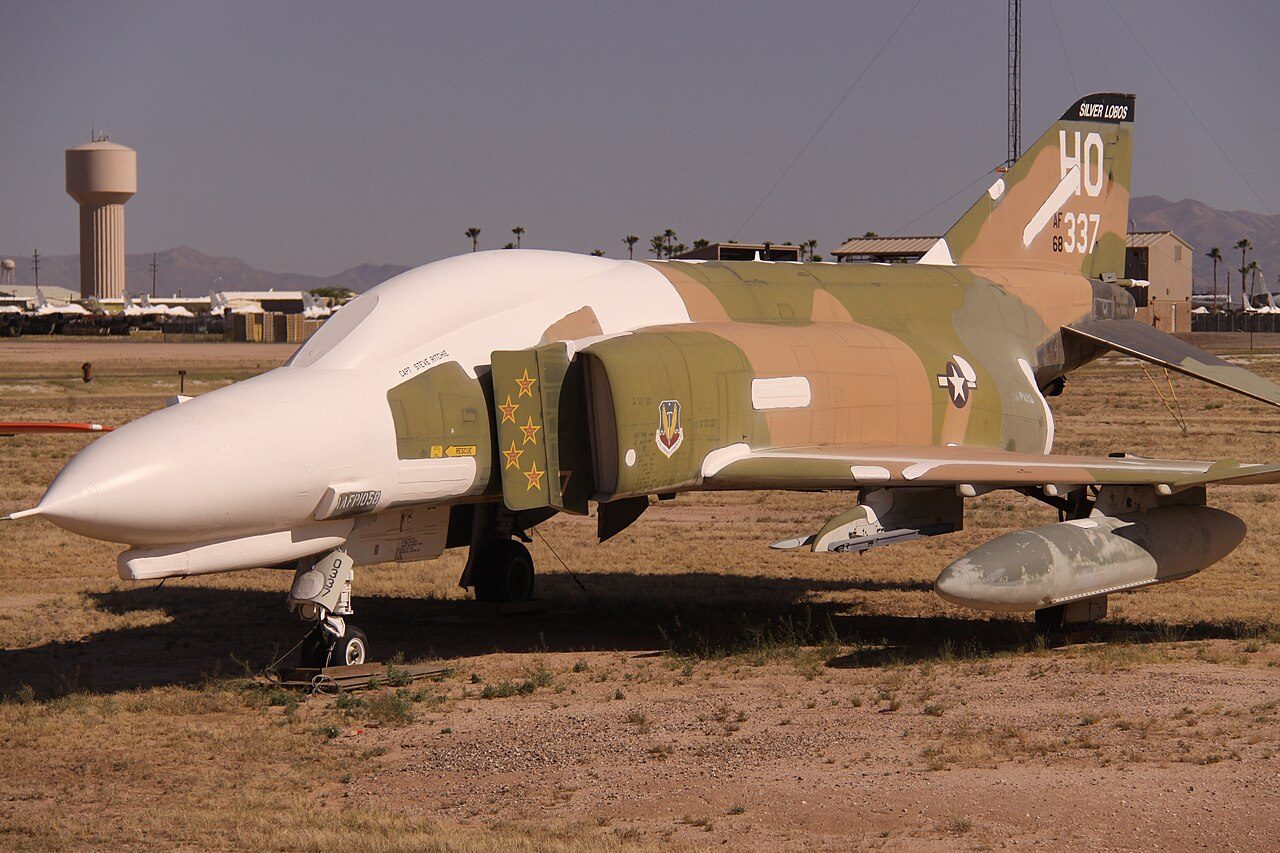
Fact cardConfidence · Source
System
TypeInterceptor aircraft
Date of introduction1972
ProliferationAt least 9 countries
Dimensions and weight
Flight performance
Service ceiling71,000 m232,940 ftAutomated check: outside the expected range for this type; verify against the source.Low[1]
Armament and payload
HardpointsUp to 18,650 lb (8,480 kg) of weapons on nine external hardpoints, including general-purpose bombs, cluster bombs, TV- and laser-guided bombs, rocket pods…Med[1]
Fire control
Variants
F-4A, B, J, N and SVariants for the U.S. Navy and the U.S. Marine Corps. F-4B was upgraded to F-4N, and F-4J was upgraded to F-4S.[1]
F-110 Spectre, F-4C, D and EVariants for the U.S. Air Force. F-4E introduced an internal M61 Vulcan cannon. The F-4D and E were the most numerously built, widely exported, and also extensively used under the Semi Automatic Ground Environment (SAGE) U.S. air defense system.[1]
F-4G Wild Weasel VA dedicated SEAD variant for the U.S. Air Force with updated radar and avionics, converted from F-4E. The designation F-4G was applied earlier to an entirely different U.S. Navy Phantom.[1]
F-4K and MVariants for the Royal Navy and Royal Air Force, respectively, re-engined with Rolls-Royce Spey turbofan engines.[1]
QRF-4C, QF-4B, E, G, N and SRetired aircraft converted into remote-controlled target drones used for weapons and defensive systems research by USAF and USN / USMC.[1]
Weapons and payload options · 1Confidence · Source
M61 VulcanGatling Gun
Med[1]- Type
- Gatling Gun
- Caliber
- 20 mm
- Rate of fire
- 7,200 rpm
The McDonnell Douglas F-4 Phantom II is a tandem two-seat, twin-engine, all-weather, long-range supersonic jet interceptor and fighter bomber originally developed for the United States Navy by McDonnell Aircraft. It first entered service in 1961 with the Navy.
Draft entry. Values come from the cited public sources and are awaiting editor verification.
- F-4E Phantom II American Interceptor Aircraft, U.S. Army TRADOC G-2 Worldwide Equipment Guide (ODIN)
Published/updated 2026-03-20 · Tier 1 · checked 2026-10-10
- 2026-10-10 Entry created from the Worldwide Equipment Guide (ODIN), bulk import
- 2026-10-10 Added photo (CC BY-SA 3.0)