
Su-25 Grach (Frogfoot)
Close air support aircraftFielded 1981Pending verification
Air ForcesRUS
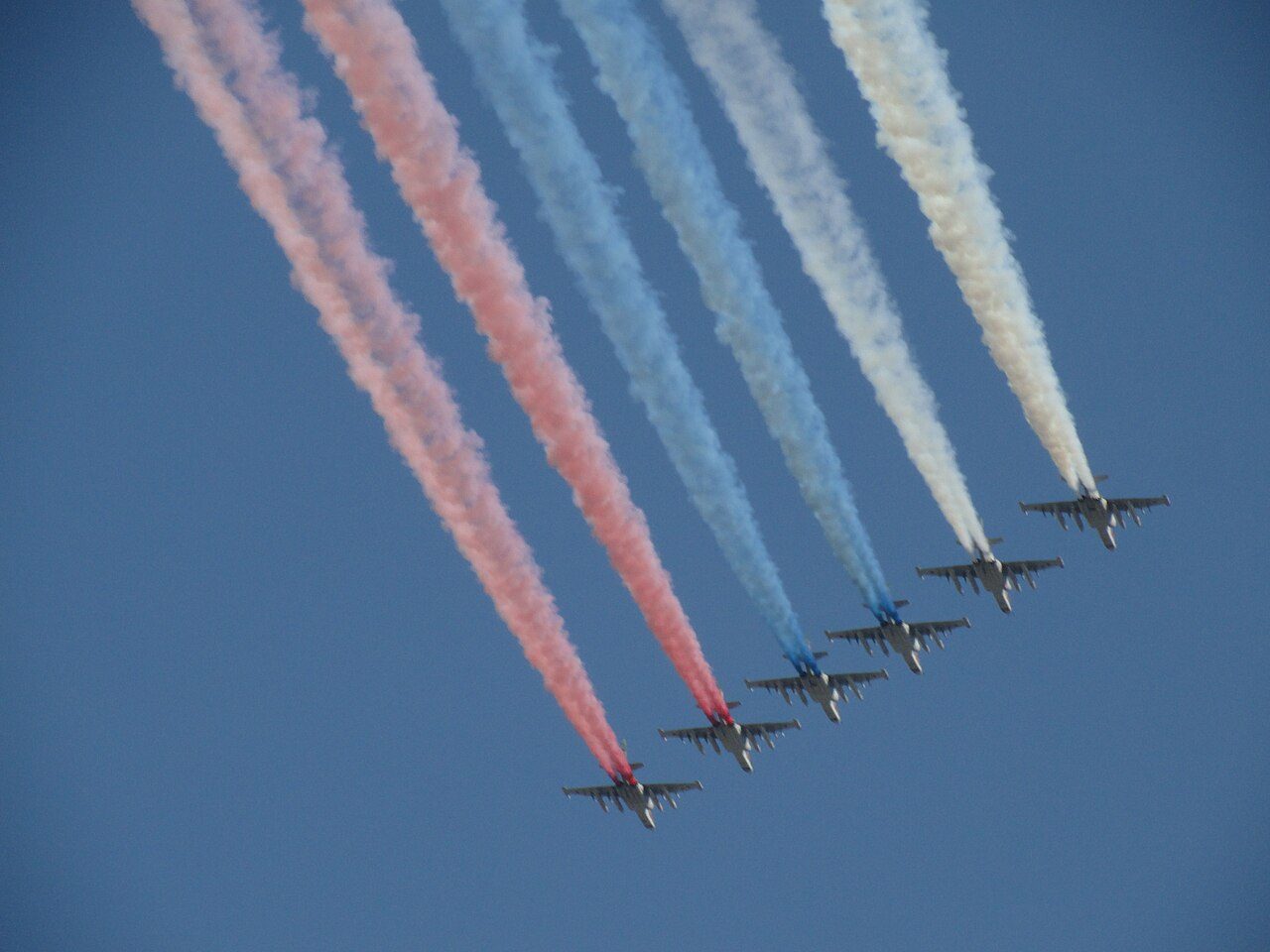
Fact cardConfidence · Source
System
TypeClose air support aircraft
Date of introduction1981
ProliferationAt least 25 countries
Dimensions and weight
Flight performance
Armament and payload
Armament1 x Gryazev-Shipunov GSh-30-2; Kh-23 Grom; NATO: A S-7 Kerry; Kh-25; NATO: AS-10 Karen; S-8; BETAB-500Med[1]
Variants
Su-25The basic version of the aircraft was produced at Factory 31, in Tbilisi, in the Soviet Republic of Georgia. Between 1978 and 1989, 582 single-seat Su-25s were produced in Georgia, not including aircraft produced under the Su-25K export program.[1]
Su-25KThe basic Su-25 model was used as the basis for a commercial export variant, known as the Su-25K (Komercheskiy). This model was also built at Factory 31 in Tbilisi, Georgia.[1]
Su-25UBThe Su-25UB trainer (Uchebno-Boyevoy) was drawn up in 1977. The first prototype, called "T-8UB-1", was rolled out in July 1985 and its maiden flight was carried out at the Ulan-Ude factory airfield on 12 August of that year.[1]
Su-25UBKFrom 1986 to 1989, in parallel with the construction of the main Su-25UB combat training variant, the Ulan-Ude plant produced the so-called "commercial" Su-25UBK, intended for export to countries that bought the Su-25K, and with similar modifications to that…[1]
Su-25UBMThe Su-25UBM is a twin-seat variant that can be used as an operational trainer, but also has attack capabilities, and can be used for reconnaissance, target designation, and airborne control.[1]
Su-25UTGThe Su-25UTG (Uchebno-Trenirovochnyy s Gakom) is a variant of the Su-25UB designed to train pilots in takeoff and landing on a land-based simulated carrier deck, with a sloping ski-jump section and arrester wires.[1]
Su-25BMThe Su-25BM (Buksirovshchik Misheney) is a target-towing variant of the Su-25 whose development began in 1986. The prototype, designated T-8BM1, successfully flew for the first time on 22 March 1990, at Tbilisi.[1]
Su-25TThe Su-25T (Tankovy) is a dedicated antitank version, which has been combat-tested with notable success in Chechnya. The design of the aircraft is similar to the Su-25UB.[1]
Weapons and payload options · 5Confidence · Source
1 x Gryazev-Shipunov GSh-30-2Autocannon
Med[1]- Range
- 1.8 km1 mi · 1 nmi
- Quantity
- 1 ea
- Type
- Autocannon
- Caliber
- 30 mm
- Rate of fire
- 1,000-3,000 rpm
Kh-23 Grom; NATO: A S-7 KerryAir-to-Air Missile
Med[1]- Range
- 2–10 km1–6 mi · 1–5 nmi
- Type
- Air-to-Air Missile
- Guidance
- Radio command guidance
- Warhead weight
- 111 kg
- Speed
- 2,160–2,700 km/h
- Length
- 3.525 m
Kh-25; NATO: AS-10 KarenAir-to-Ground Missile
Med[1]- Range
- 11 km7 mi · 6 nmi
- Type
- Air-to-Ground Missile
- Guidance
- Laser guidance, passive radar, TV guidance, IIR, Satellite guidance, active radar homing depending on varian
- Warhead
- High explosive, shell-forming
- Warhead weight
- 89.6 kg
- Speed
- 1,370–2,410 km/h
- Length
- 370.5 cm
S-8HEAT Rocket
Med[1]- Range
- 1–4 km1–2 mi · 1–2 nmi
- Type
- HEAT Rocket
- Warhead weight
- 3.6 kg (0.9 kg of Hecphol-5/A-IX-10 explosive)
BETAB-500Concrete-Piercing Bomb
Med[1]- Type
- Concrete-Piercing Bomb
- Length
- 2,200 mm
The Su-25, which is no longer in serial production, made its first flight in 1979. This single-seat ground-attack aircraft is a very durable airplane - it is fairly heavily armored -- and easy to service - all service equipment can be stored in a container and transported by the airplane itself.
Draft entry. Values come from the cited public sources and are awaiting editor verification.
- Su-25 Grach (Frogfoot) Russian Close Air Support Aircraft, U.S. Army TRADOC G-2 Worldwide Equipment Guide (ODIN)
Published/updated 2026-03-20 · Tier 1 · checked 2026-10-10
- 2026-10-10 Entry created from the Worldwide Equipment Guide (ODIN), bulk import
- 2026-10-10 Added photo (CC BY-SA 2.0)